
Kategorie-Archive: F

Focus stacking

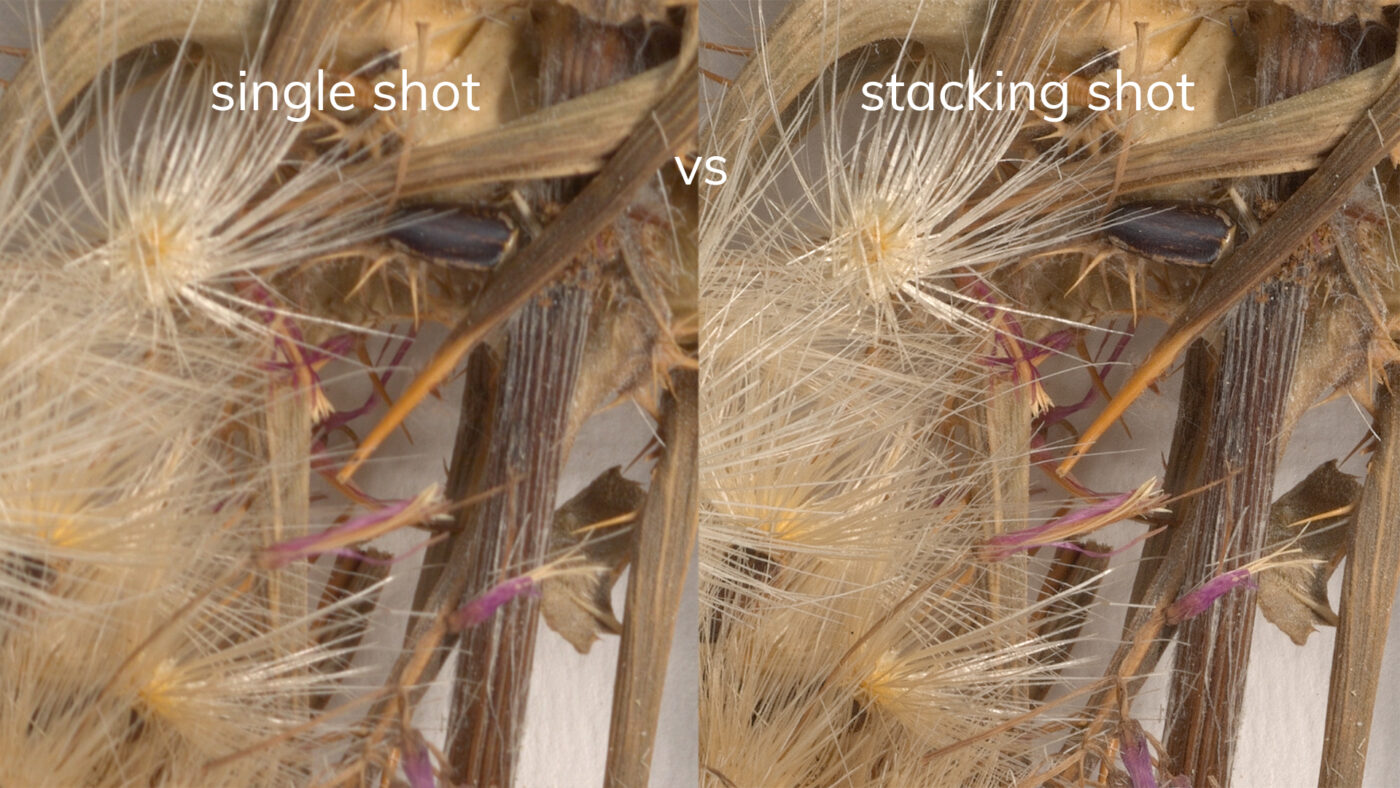
Focus stacking is a method of maximizing the depth of field of an image. Several images of an object are taken within a very short time, whereby the focus point is shifted slightly with each image. In this way, a new, very small area is precisely captured step by step for each image. These images are then stacked using the software, i.e. combined in such a way that only the sharp areas of each photo are integrated into the final image. The end result is a consistently sharp image with maximum detail.

We offer two methods for this: firstly, changing the focal plane by moving the camera to a new position on the camera slider, whereby the secure fixing on the slider also prevents any shifts or distortions, and secondly by controlling the lens and the focus setting via a motorized focus. In both cases, the process can be precisely programmed using presetting in our scanning software. The result is a razor-sharp image of incredible detail, which can provide scientists with new information for analysis and comparisons and is a real eye-catcher for aficionados.

However, focus stacking is not only the ideal solution for the digitization of herbaria but is also suitable for all collections whose objects have three-dimensional structures and whose details are to be examined more closely: whether insects, coins, pottery fragments, textile fragments, etc. – there are virtually no limits to the possible applications.

Our new tool is being used for the first time in an extensive project at the Thuringian University and State Library Jena (ThULB) to digitize the Herbarium Haussknecht (JE) with our high-performance scanner book2net Archive Pro A2+
Related Topics

Auflösung

Was bedeutet eigentlich Auflösung in der Welt der [...]

Read More
Schärfeebene

Durch die Verwendung von Flächensensoren in unseren Systemen [...]

Read More
Tiefenschärfe

Die Tiefenschärfe oder auch Schärfentiefe gibt an, in [...]

Read More

Fluorescence

Fluorescence refers to the ability of some atoms and molecules to absorb light at a certain wavelength (the excitation: Ex, excitation) and then to emit light of a longer wavelength during a short-lived emission (Em).

Art technology, among others, makes use of this property when examining works of art. Properties can be detected and assigned to specific materials; the spectrum thus becomes material-specific, a kind of optical fingerprint. The storage of such reference spectra in reference databases supports the work of scientists in their research.

Related Topics

UV-Fluoreszenz

Die UV-Fluoreszenzuntersuchung ist eine zerstörungsfreie Untersuchungsmethode, die bei Kunstwerken [...]

READ MORE
Multispektralfotografie

book2net hat ein neuartiges Verfahren zur Multispektralanalyse von Dokumenten [...]

READ MORE

False colors

Imaging techniques such as multispectral photography make it possible to convert the spectral composition of image elements on the „input side“ into a different color space and thus output them as a „false color“ (or false color); i.e., colors that deviate from the natural color impression are deliberately used.

An unintentional false color display can occur as a color cast, for example, if the white balance has failed.

False color imaging is based on the principle that the human eye perceives only a few hundred brightness levels of a color tone, but can distinguish about a million color shades. Therefore, a false color image uses a color scale instead of a gray scale. The color channels of the original image are assigned to other colors – for example, red to blue and blue to green. This allows individual details of the captured originals to be seen more clearly, provided that the color gradient is uniform to the eye.

In the field of art technological analysis, false color images are used to make fine nuances of a color tone or a gray level in a work of art clearly distinguishable.

Related Topics

Multispektralfotografie

book2net hat ein neuartiges Verfahren zur Multispektralanalyse von Dokumenten und Zeichnungen [...]

READ MORE
Farbspektrum

Farbspektrum siehe Lichtspektrum

READ MORE
RGB-Farbraum

Ein Farbraum ist ein definierter Bereich von Farben. Farbraum bedeutet die [...]

READ MORE
ECI-RGB-Farbraum

Der ECI-RGB V2 Farbraum ist einer der standardisierten RGB-Farbräume. Er ist [...]

READ MORE

Flatbed scanner

In contrast to planetary scanners, which are operating contactless with incident light, flatbed scanners work on the same principle as a copier: The original is placed on a pane of glass and light-sensitive sensors are guided under the pane of glass during scanning.

This method makes it possible to scan not only single pages and photos but also bulky documents such as books. However, in order to achieve a sharp image, the original usually has to lie flat on the glass plate. This can lead to irreparable damage to the book spine due to the high pressure load. In addition, the handling is very cumbersome as the flap has to be opened each time for the next scan; the book has to be taken out, the page turned again, etc. Likewise, this type of scanning does not allow a distortion-free and reproducible capturing of the original.

Some flatbed scanners also have a document feeder for single pages. Inexpensive flatbed scanners are therefore mainly used in office operations, where documents are mostly scanned in A4 up to A3 format.

High-priced flatbed scanners, especially in the large format area, also work with conservative LED lighting and high-resolution line sensor technology, which also enables digitization without pressure to a certain extent, but is clearly inferior to planetary scanners in terms of protection of the originals, handling and productivity.

Related Topics

Dokumentenscanner

Dokumentenscanner sind in der Regel Einzugsscanner, die auf Produktivität ausgelegt sind, [...]

READ MORE
Auflichtscanner

Analog zur Bezeichnung Auflichtscanner werden auch die Begriffe Aufsichtscanner oder Buchscanner [...]

READ MORE

Focus level

We use the term „focus level“ to refer to the area of a document or original that lies in the focus of the imaging unit. See also Focus.

By using area sensors in our systems, we reproduce a high depth of field. Therefore, our actual focus level is more of a three-dimensional construct, which allows for a certain degree of tolerance. So, unlike line scanners, for example, our scanners are not reduced to a fixed level.

However, it makes sense to work in the optimal focus level in order to achieve the best possible results. In order for the user to quickly recognize where this level is located, even with originals of different thicknesses or heights, LED lines indicate this area before the scan. Using the book cradle and a motorized height adjustment, the originals can be moved up or down to reduce or increase the distance to the image acquisition unit.

Related Topics

Fokus

Der Fokus oder auch Brennpunkt beschreibt in der [...]

READ MORE
Tiefenschärfe

Die Tiefenschärfe oder auch Schärfentiefe gibt an, in [...]

READ MORE
Buchwippe

Bei der Buchwippe (auch Buchwiege) handelt es sich [...]

READ MORE

Focus value

To set the acquisition unit to the optimum focal level, our systems offer different approaches. Depending on the original or requirement, individual focusing can thus take place. In addition to motorized autofocus or adjustment with visual support via the video mode, there is also the option of displaying a digital sharpness value.

This value is an unspecified number that becomes visible in the upper left corner of the user interface when activated. The acquisition unit or the optics can now be adjusted to find the focus. This involves a permanent measurement of the contrasts over the entire scan area. The number either increases when the image is sharpened or decreases when the image is blurred and therefore less contrast can be measured.

The goal is to find the „peak“, the point where the number is highest before it gets smaller again. If you reach this peak, you have found the optimal plane of sharpness.

The digital sharpness value is another user-friendly, supporting function for achieving an optimal scan result. It is not subject to subjective decisions, but indicates on a mathematical basis which setting is best suited for the respective original.

Related Topics

EasyScan-Scansoftware

Unsere Software Easy Scan ist die anwenderfreundliche Benutzeroberfläche [...]

READ MORE
Fokus

Der Fokus oder auch Brennpunkt beschreibt in der [...]

READ MORE
Autofokus

Der Autofokus ist eine Funktion, die man üblicherweise [...]

READ MORE
Motorfokus

Unsere Systeme arbeiten vorzugsweise mit einer Festbrennweite. Das [...]

READ MORE

FADGI

The Federal Agencies Digital Guidelines Initiative (FADGI) The Federal Agencies Digital Guidelines Initiative (FADGI) was founded in 2007 as a collaborative effort by different federal agencies in the United States to articulate common technical guidelines, methods and practices for the archiving of digitized and born digital documents of historical and cultural importance. These standards have been given heightened urgency by the US government’s initiative to stop the flow of analog documents into the National Archives after 2022 in favor of electronic records.

Two working groups deal with the two main themes: the audiovisual and still images. With a ranking of one (low) to four (high) stars, performance parameters were created based on a comprehensive numerical analysis of the accuracy and quality of the digital copies for varying media.

The guidelines are published and updated viahttp://www.digitizationguidelines.gov/.

related topics

Digitalisierungsrichtlinien

Die Qualität eines Digitalisierungsprozesses unterliegt verschiedensten Faktoren. Sie ist abhängig von Komponenten wie der verwendeten Scanner-Hardware (Sensortechnologie und Qualität [...]

READ MORE
ISO/TS 19264-1:2017

2012 hat die ISO (International Organization for Standardization) begonnen einheitliche Standards im Bereich der Digitalisierung und Langzeitarchivierung festzulegen, um [...]

READ MORE

Focus

In physics, the focus describes the point in an optical system where the light rays intersect after passing through the optics. At this point, therefore, the information that previously ran parallel is centered and thus fully captured. Most often, the term focus is used to mean that something is displayed in optimum sharpness. Depending on the device and the system, the determination of the focus is done selectively, centrally or point by point.

In our systems, the focus is determined over the entire scan area by means of a contrast measurement. Where the contrast is highest is the optimum sharpness plane, i.e. the focus. By looking at the entire scan area, it is ensured that the edge areas are also optimally sharp and not just the center of the original.

Related Topics

Motorfokus

Unsere Systeme arbeiten vorzugsweise mit einer Festbrennweite. Das [...]

READ MORE
Autofokus

Der Autofokus ist eine Funktion, die man üblicherweise [...]

READ MORE
Schärfeebene

Durch die Verwendung von Flächensensoren in unseren Systemen [...]

READ MORE
Tiefenschärfe

Die Tiefenschärfe oder auch Schärfentiefe gibt an, in [...]

READ MORE

Filter

A filter is usually a thin transparent sheet of glass or plastic that is attached to the front of the lens to alter the image as it is taken. There are filters with specific tasks to enhance the image, and there are filters that give photographers creative options, such as color or graduated filters. The former include infrared or UV filters, which ensure that neither UV nor infrared light passes through the optics and onto the sensor, adversely discoloring the image. Polarizing filters are also often useful, as they can prevent reflections and over-illumination. This prevents information loss in said areas.

An important field of application for filters is especially multispectral photography, since filters can be used to select a wide variety of light wavelengths and bring them specifically onto the sensor.

Related Topics

Objektiv

Jede Kamera benötigt ein Objektiv, um das aufzunehmende [...]

READ MORE
UV-Licht

UV-Licht,  auch als Ultraviolett-Strahlung oder UV-Strahlung bezeichnet, kann [...]

READ MORE

Fresnel lens

This term refers to a one-dimensional lens system that performs corrections in only one dimension. In book2net book scanners, the light system is usually located at the rear to avoid uncontrolled reflections into the optics caused by the curvature of the page. The LED light strip ideally illuminates the book in landscape format, but the different light paths on the surface result in different light intensities from back to front. A Fresnel lens compensates for this by directing more of the short beams to the back. We therefore use these lenses, adapted to specific applications, as fixed components of our high-quality systems.

Related Topics

Homogenes Licht

Unter homogenem Licht oder auch homogener Ausleuchtung versteht [...]

READ MORE
UV-Licht

UV-Licht,  auch als Ultraviolett-Strahlung oder UV-Strahlung bezeichnet, kann [...]

READ MORE
Dauerlicht

Unter Dauerlicht versteht man in der der künstlerischen [...]

READ MORE
Lichtempfindlichkeit

Hohe Lichtintensität kann bei empfindlichen Kunstwerken, insbesondere bei [...]

READ MORE